Skip to content

Decision Support System

Transforming Complex Climate Evidence into Resilient Policy Decisions

Making Climate Risk Evidence Actionable

Climate change impacts European regions and critical economic sectors in markedly different ways. Developing genuine resilience requires more than raw climate projections: decisionmakers must examine localised socio-economic vulnerability, evaluate cross-sectoral impacts, and assess the viability of concrete policy interventions.

The CROSSEU Decision Support System (DSS) bridges the gap between scientific modelling and real-world policy planning. Developed under the EU Horizon Europe CROSSEU project, this interactive web platform integrates high-resolution biophysical impact models, socio-economic vulnerability metrics, empirical case study data, and curated European governance information into an accessible, responsive dashboard.

The platform reduces the complexity of raw scientific datasets, empowering public authorities, regional planners, and researchers to explore multi-hazard risks and extract evidence-backed adaptation options across Europe's climate hotspots.

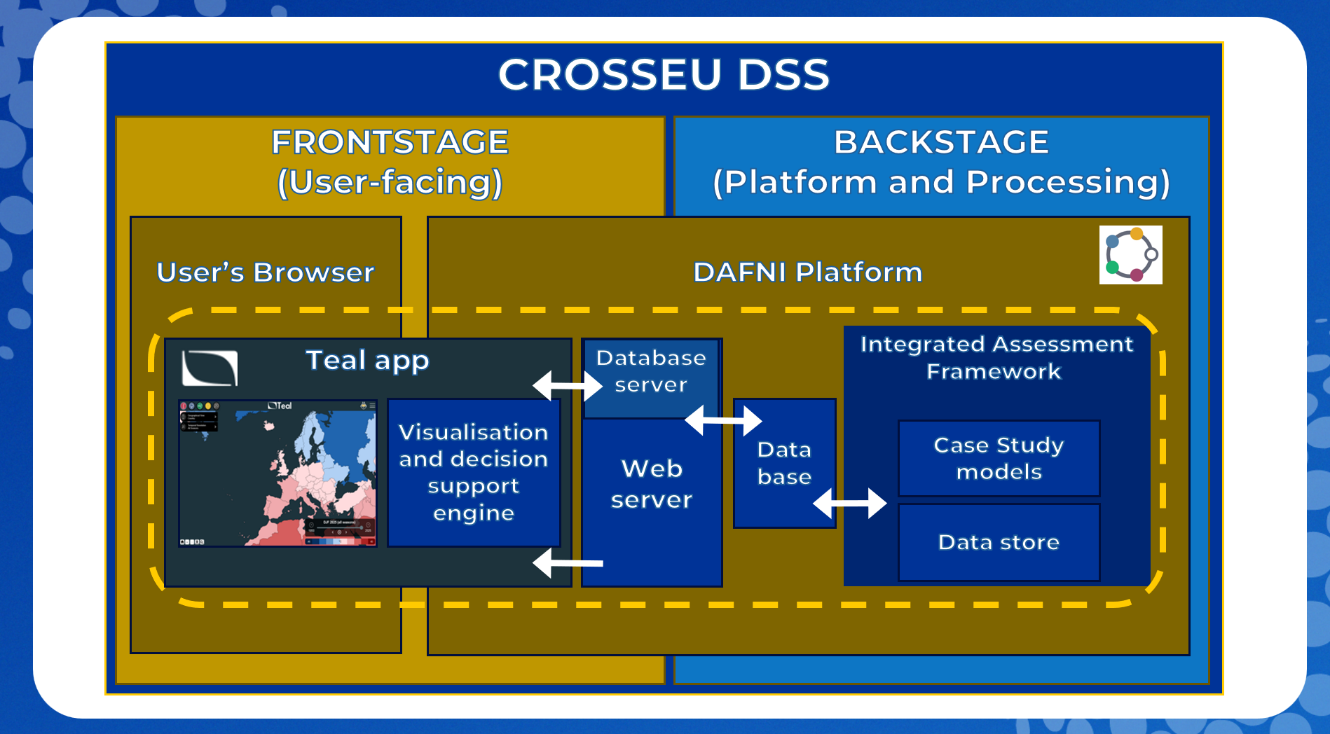
The CROSSEU DSS hybrid architecture: Decoupled interactive frontend (Teal by WEMC) seamlessly connected to high-capacity computing and data repositories (DAFNI by UKRI).

How to Access the Platform

The CROSSEU DSS and its individual case study dashboards are hosted natively on the UKRI DAFNI (Data & Analytics Facility for National Infrastructure) secure platform.

Current Access (Prototype & Demonstration Phase):

Exploring the CROSSEU project catalogue and launching case study dashboards currently requires a free, standard DAFNI user account. Account creation is immediate and takes less than a minute. Once logged in, users can launch any case study dashboard directly within their web browser.
What Can You Do with the DSS? Dual System Pathways

The CROSSEU DSS resolves the trade-off between technical depth and policy accessibility by offering two interconnected interaction modes powered by the same underlying data:

CROSSEU DSS Platform
Exploratory Pathway(For Analysts & Researchers) Narrative Pathway(For Policymakers & Planners)
Multi-scenario navigationStoryline-driven policy questions
Bespoke multi-region chartingAutomated UI & layer setup
Sub-regional & gridded inspectionDirect link to adaptation options
Full variable configurationOne-click Summary PDF briefing

01 The Exploratory Pathway: Data-Driven Inquiry for Analysts

Designed for technical specialists, researchers, and climate adaptation officers who require complete analytical flexibility with minimal interface constraints.

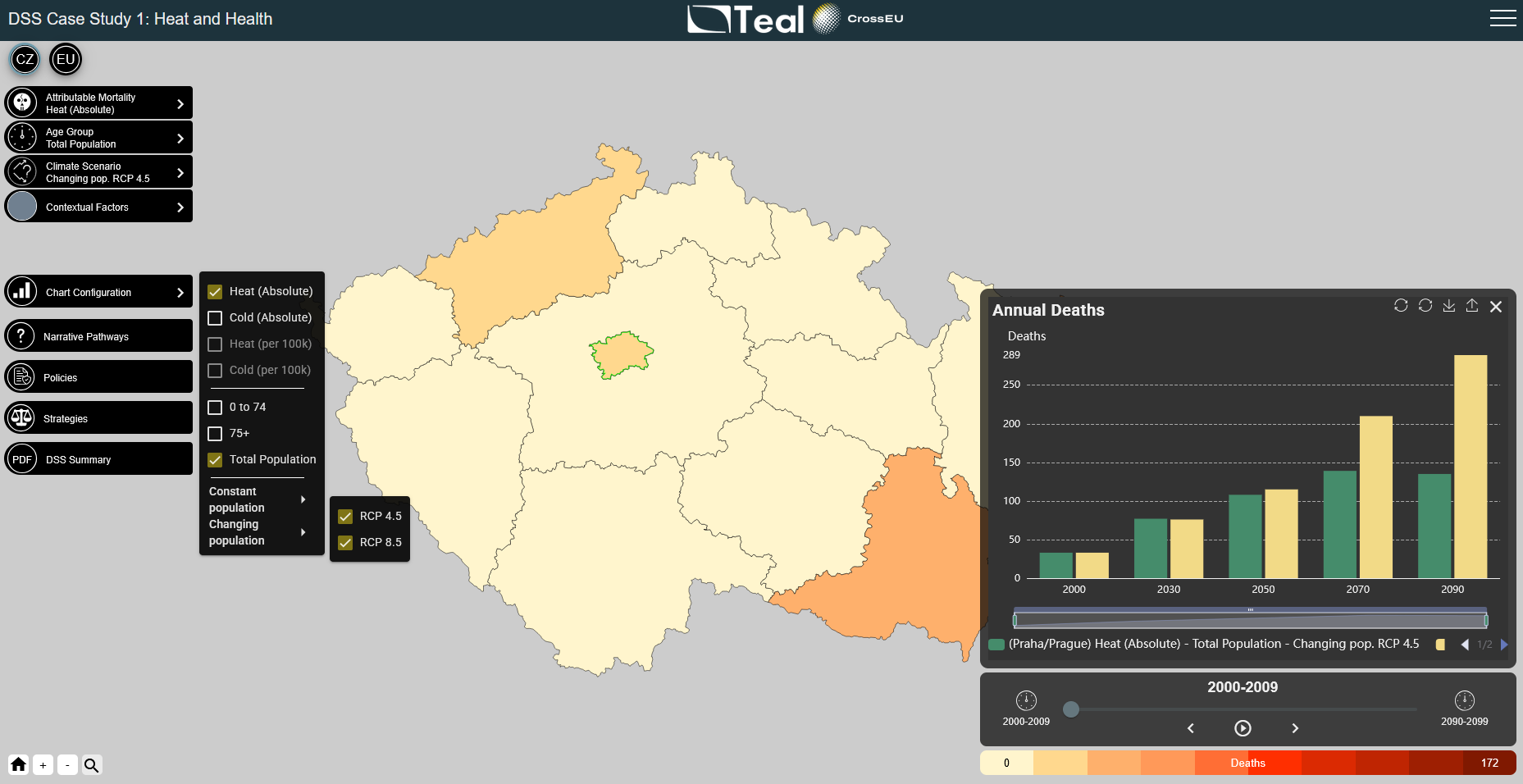
  • Multi-Scenario Interrogation: Examine historical baselines alongside future climate pathways (RCP 4.5, RCP 8.5 / SSP combinations) through time horizons up to 2100.
  • Dynamic Regional Comparison: Select single or multiple administrative territories (NUTS3 sub-regional boundaries) to compare vulnerability indicators and hazards side by side on dynamic charts.
  • Configurable Charting Engine: Move beyond static graphs using a built-in chart maker to generate relevant graphics such as time series, boxplots, and histograms, with interactive controls to sort and filter regional distributions.
  • Temporal Navigation: Utilise interactive date-time sliders to scroll smoothly through multi-decadal projections and seasonal timesteps.
The Exploratory Pathway in action: Interactive European risk mapping, timeline navigation sliders, and indicator selectors.

02 The Narrative Pathway: Guided Decision Support for Policymakers

Designed for local planners, regional directors, and non-technical stakeholders who need clear, evidence-based answers to pressing policy questions without navigating complex database parameters.

  • Storyline-Driven Questions: Select from a curated library of real-world policy questions tailored to each regional case study (e.g., "How will drought frequency threaten regional hydropower generation by 2050?").
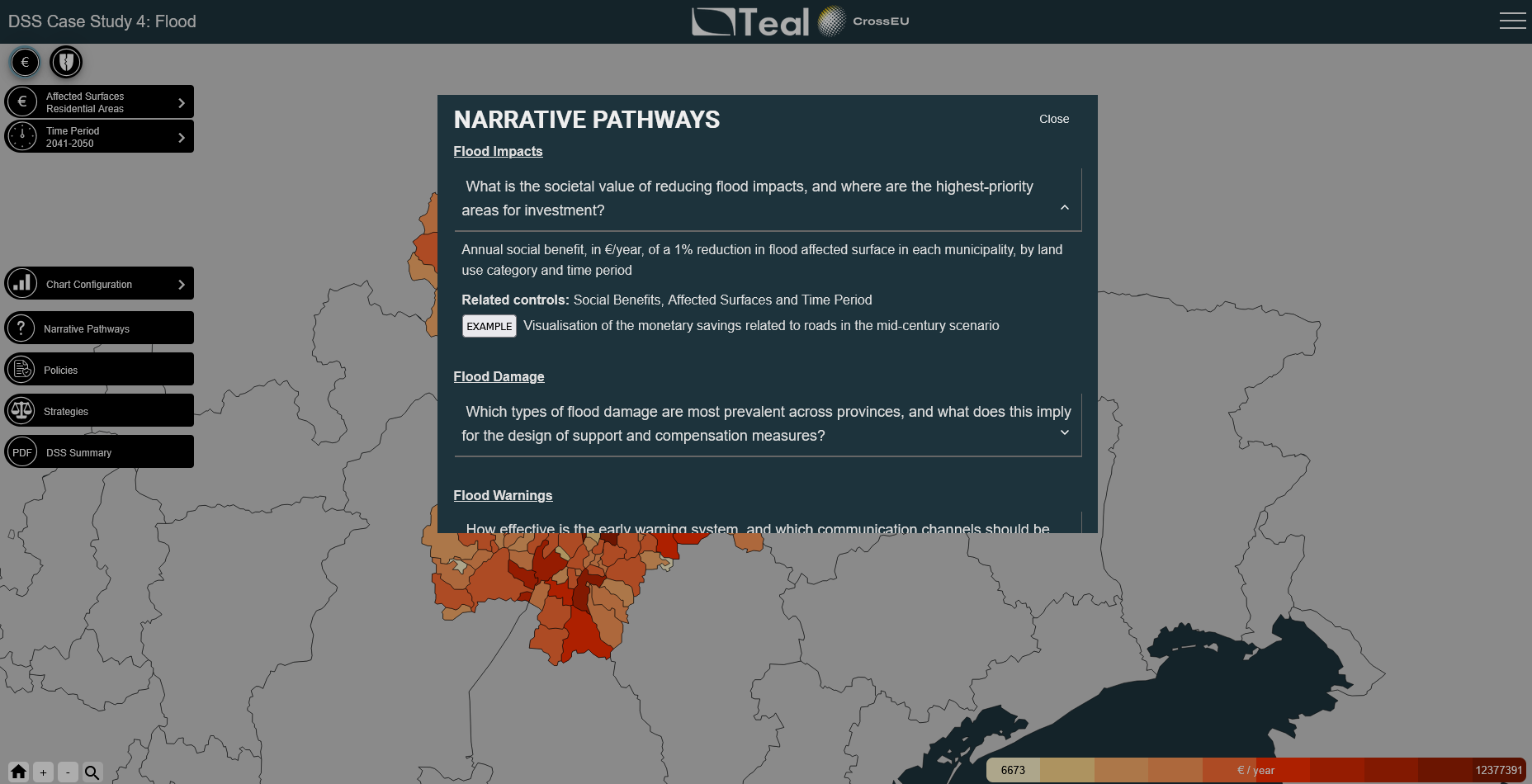
  • Automated Dashboard Configuration: Clicking an example question automatically reconfigures the menus, pulls the exact data indicators required, renders the corresponding regional map, and opens the pertinent chart.
  • Contextual Policy Matrix: Directly connects observed climate hazards to the policy and governance knowledge base developed under CROSSEU Work Package 4, outlining viable regional strategies, sector-specific directives, and relevant EU frameworks with relevant web links. This feature is also available in the exploratory pathway.
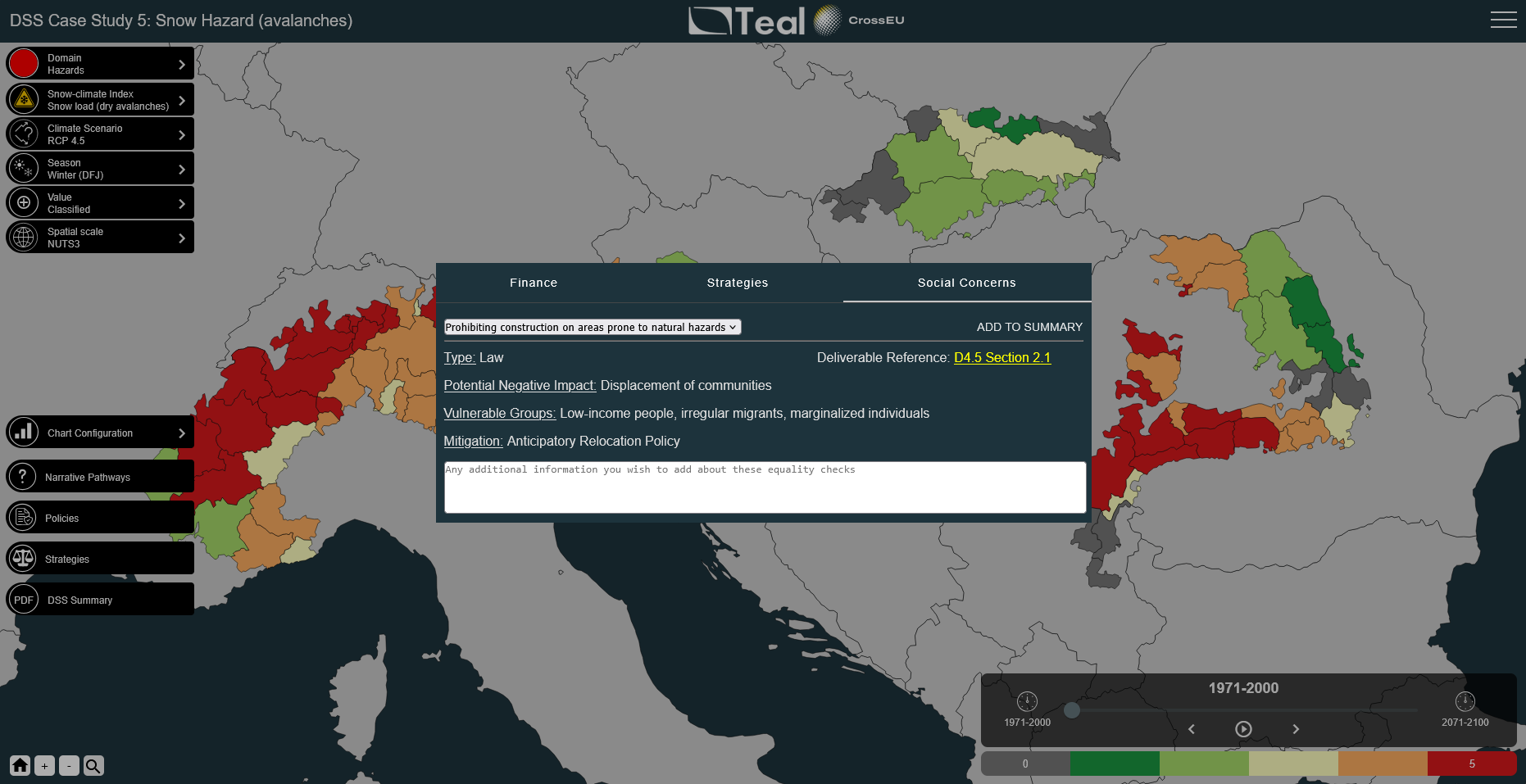
The Narrative Pathways interface: Step-by-step guidance translating complex multi-hazard storylines into concrete policy questions and adaptation choices.
Policy information dialogues

03 Automated Summary PDF Briefing Generator

Both pathways feed into an automated reporting tool designed to support briefings, meetings and reports:

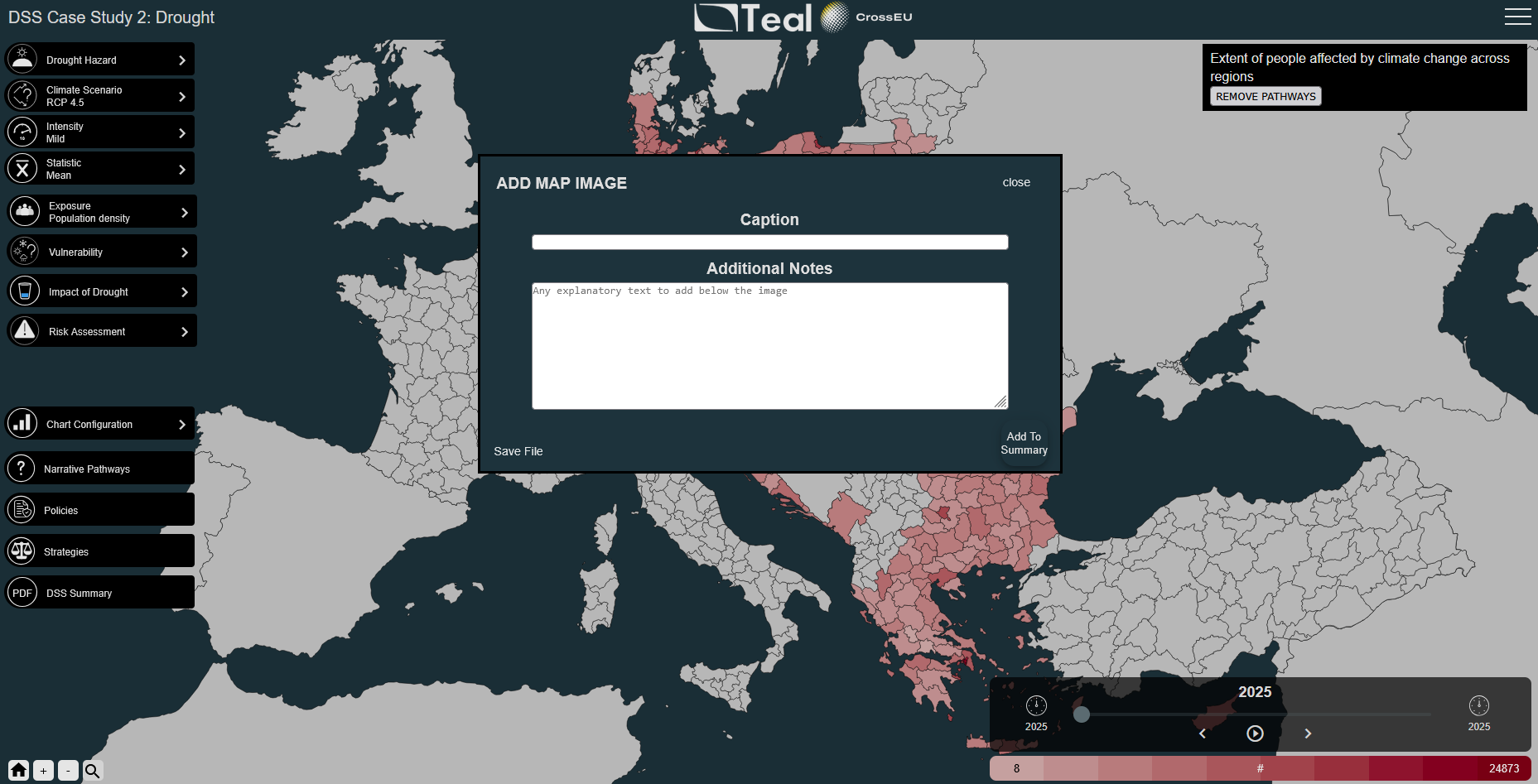
  • Snapshot Compilation: Capture active map visualisations, dynamic chart images, and relevant policy options with a single click or keyboard shortcut (Alt+M for map snapshots, Alt+C for charts).
  • Custom Annotations: Add localised commentary, executive summaries, and user notes.
  • Exportable Policy Briefing: Compile the collected evidence into a clean, downloadable PDF report containing metadata, live web links, and citable sources.
Adding content to the PDF document

User Guide, Tutorials & Demonstration Walkthroughs

A User Guide for the visualisations is available on the DSS landing page, and the video guide below provides step-by-step instructions for using the platform:

Video 1: Getting Started with CROSSEU on DAFNI

How to access the platform, register a free account, and navigate the central project landing page.

Built on World-Class Open Science Infrastructure

The CROSSEU DSS brings together specialised, complementary technical components:

  • Frontend Visualisation Engine (Teal): Developed by the World Energy and Meteorology Council (WEMC), Teal provides the responsive user interface, map rendering, and dynamic charting components.
  • Backend Integrated Assessment Framework (IAF): Powered by the DAFNI platform operated by UK Research and Innovation (UKRI), providing secure container orchestration, automated Kubernetes deployment pipelines, and high-performance in-memory database querying (DuckDB).
  • Traceable Open Science: Through DAFNI's Reference Datasets and Reference Models, the platform catalogues all input and output data, and workflow steps—even when hosted externally—ensuring complete scientific transparency and a lasting research legacy for future EU climate initiatives.

Who is the CROSSEU DSS Designed For?

Regional & Municipal Decisionmakers:

Understand specific hazards in your territory and evaluate the socio-economic impacts of projected climate scenarios.

National Policymakers & Public Agencies:

Access consolidated, cross-sectoral evidence to prioritise adaptation investments and align regional action with EU climate targets.

Climate Risk Analysts & Researchers:

Interrogate multi-model projections, examine uncertainty bounds, and download standardised data tables for academic analysis.

Infrastructure Operators & Sector Managers:

Evaluate resilience vulnerabilities across energy sector, transport links, agricultural supply chains, and municipal water resources.

© LGI Sustainable Innovation 2024 | All Rights Reserved