
What is the CROSSEU Decision Support System?
2026-05-24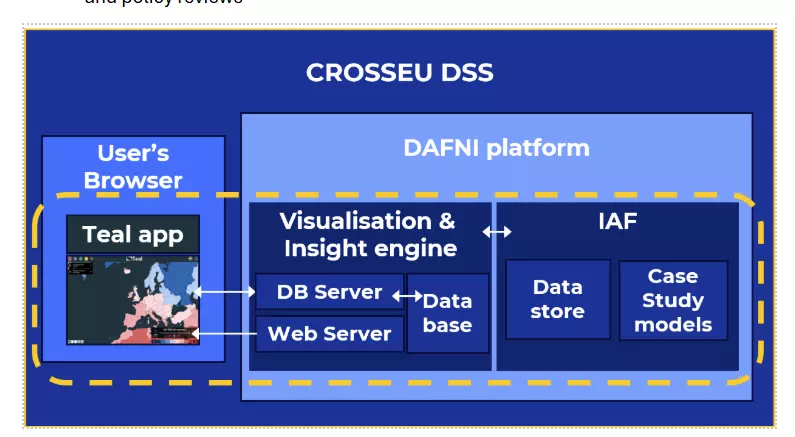
The CROSSEU Decision Support System (DSS) is being developed to provide an accessible, scientifically robust, and stakeholder‑driven platform for understanding climate risks and supporting equitable adaptation planning across Europe. It brings together climate science, socio‑economic analysis, and participatory co‑design to generate actionable insights for decision‑makers at regional and local scales.
The CROSSEU DSS comprises of several components:
- A back-end platform to host software and data in the Integrated Assessment Framework (IAF) on DAFNI, the Data & Analytics Facility for National Infrastructure at UK Research and Innovation (UKRI)
- A front-end user interface, Teal, from the World Energy and Meteorology Council (WEMC), an online application developed through co-production with stakeholders
- The results from the CROSSEU project case studies, socioeconomic modelling and policy reviews
Built on DAFNI and Teal foundations
The back-end power of the DSS, DAFNI, provides a secure, cloud-based platform for hosting CROSSEU datasets and executing computational models, such as economic and biophysical impact models. By running these models in containerised environments on DAFNI's dedicated servers, the DSS can process, standardise, and query complex data behind the scenes. This robust infrastructure ensures that the DSS is not only highly stable and secure but also optimised for long-term public availability and scalability.
The DSS interface builds on the long-established Teal tool, developed by WEMC over several major European and international projects. Teal began under the Copernicus Climate Change Service (C3S) Climate and Energy Education Demonstrator and was completed as part of the H2020 SECLI‑FIRM project, with further enhancements under the H2020 FOCUS‑Africa project. It provides a mature foundation that combines a solid and extensible database architecture, advanced automated processing routines, and a user-friendly visual interface. Its database structure is built on an extended SQL implementation, supported by a rigorous data management plan refined over many years. Teal already includes a range of modules, including publicly available historical and projection data and representations of socioeconomic and climate risk indicators. A key strength of Teal is its capacity to operate on multiple spatial scales and combine visualisation, data and interpreted information downloads.
In addition to hosting the CROSSEU IAF, DAFNI infrastructure also hosts the interactive frontend Teal visualisation instances themselves. This unified hosting ensures that the entire system is highly stable, secure, and optimised for long-term public availability and scalability.
These capabilities make these tools ideal for the development of the CROSSEU DSS.
What the final DSS will enable
The CROSSEU DSS is designed as an interactive platform that guides users through understanding and assessing climate risks relevant to their region or sector of interest. Users will be able to choose from two pathways, the first to explore and compare information across regions, asset types, hazards, and other characteristics giving impact results for multiple regions, scenarios or future periods. The second is to use narratives to guide the user through appropriate choices to produce insights from an engine populated with climate and socioeconomic data and policy input from CROSSEU assessments.
Users can generate downloadable summaries of findings and information on policy actions, tailored to the options they select.
Co‑designed with stakeholders
A feature of the CROSSEU DSS is its collaborative development approach. The system is co‑designed with stakeholders from the project’s case studies, ensuring that it reflects real‑world decision contexts and practical needs. Through this approach, the DSS aims to deliver information that is understandable, policy relevant, and aligned with users’ workflows.
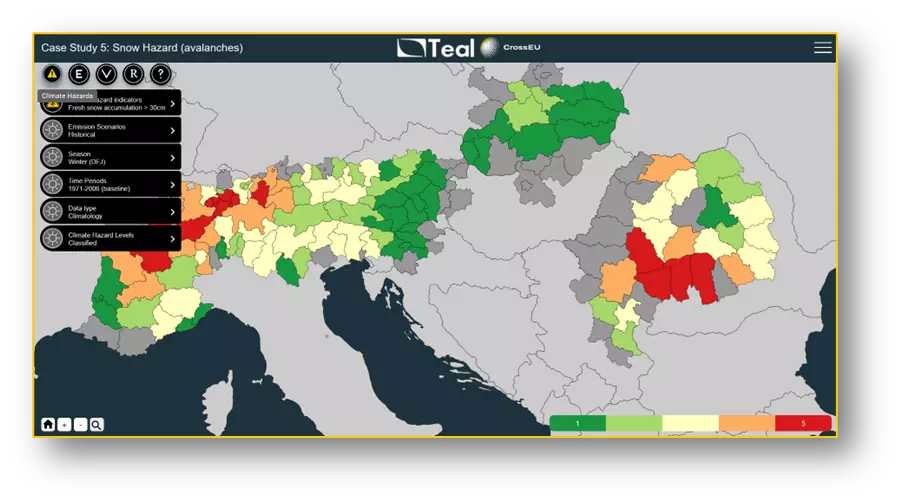
The DSS user interface is designed to combine three major components:
- A user selection menu for configuring variables such as hazard type and asset characteristics.
- Visualisation and communication functions, including downloads and autogenerated summary PDFs.
- User narrative pathways for simplifying data selection and summarising policy-relevant information.
Future development
As the CROSSEU project progresses, the DSS will expand to include all possible data from case studies, policy and other supplemental information covering multiple sectors and regions. Future enhancements will increase interactivity, improve indicator selection through user-driven pathways, and incorporate iterative feedback gathered through participatory engagement processes. The aim is to create an accessible, and equity‑focused tool supporting climate‑resilient policy‑making across Europe.
What to read next
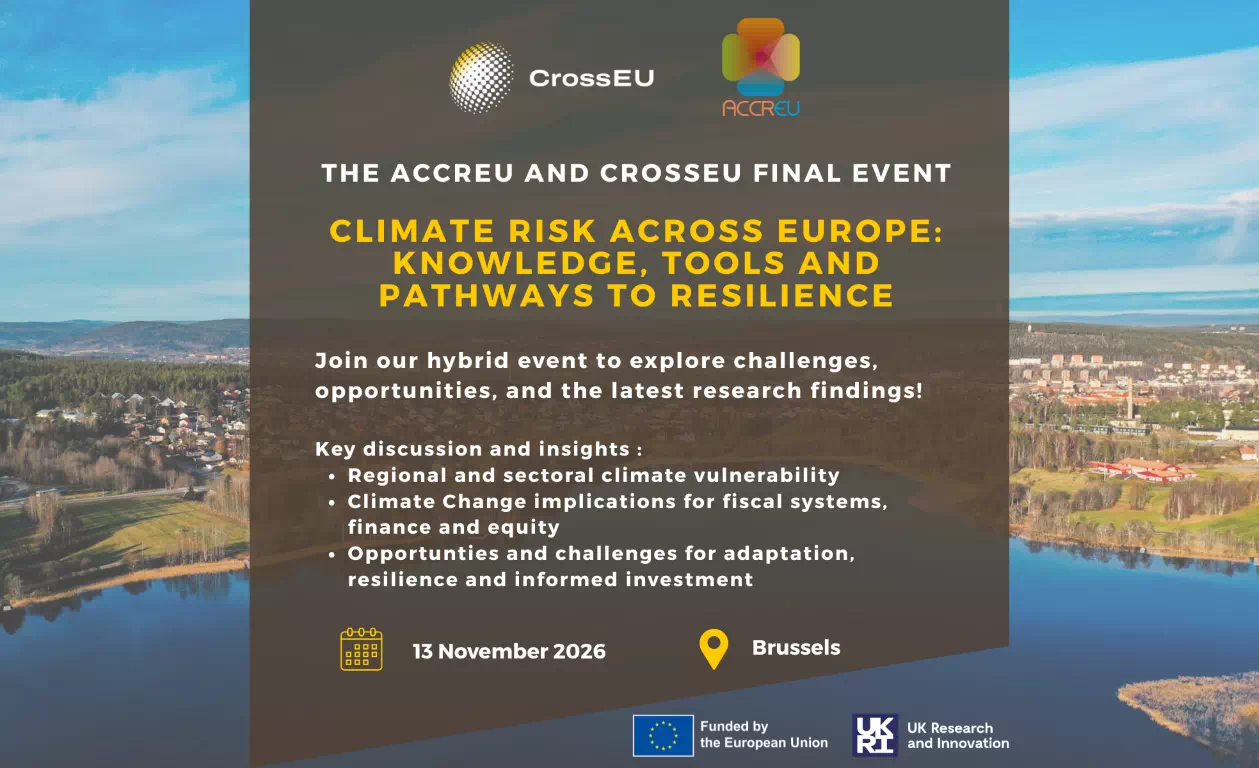
ACCREU and CROSSEU Final Conference - Climate Risk Across Europe: Knowledge, Tools and Pathways to Resilience
Join the ACCREU and CROSSEU final hybrid event to explore climate vulnerability, the implications of climate change for finance and equity, and pathways towards adaptation and resilience.

CROSSEU Highlights the Importance of Social Impacts in Climate Risk Assessment at EU Green Week 2026
CROSSEU participated in the EU Green Week 2026 webinar Climate Risks and Biodiversity for European Resilience and a Nature-Positive Economy, alongside fellow Horizon Europe projects SPARCCLE and ACCREU.

CROSSEU Policy Brief under way: Climate Change
As the CROSSEU project progresses, its research findings are being translated into practical outputs that support evidence-informed climate action across Europe.